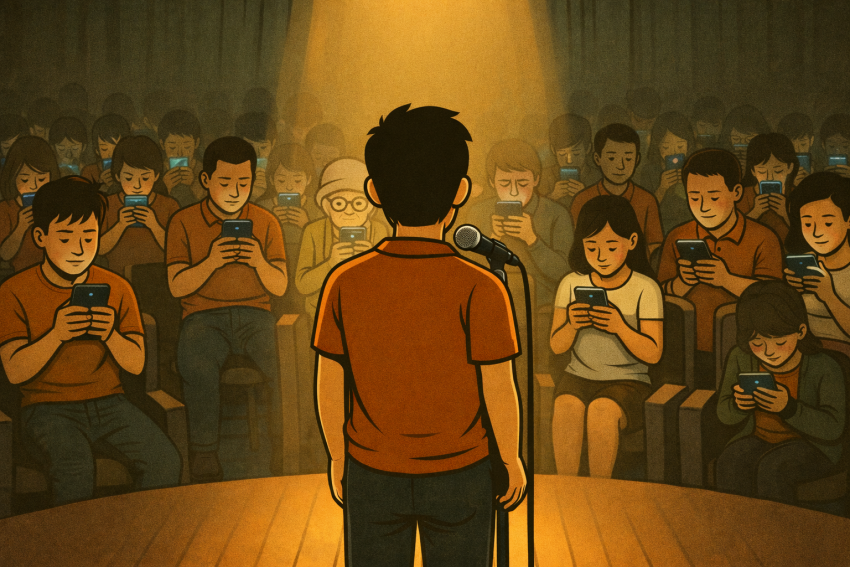
There was a time when things just happened and that was enough. You went out to dinner and nobody paused the table so it could be arranged first. You took a trip and you took photos, sure, but they were for you. Maybe for a shoebox, maybe to show a few people later. They weren’t immediate, they weren’t constant, and they weren’t shaped for an audience. You had a good night with people you cared about and it didn’t cross your mind how it would look to anyone else. Now it’s different. Not in some dramatic, overnight way. It just kind of crept in and made itself at home. Somewhere along the line, we stopped just living and started thinking about how our lives look while we’re living them.
It starts small. You take a photo to remember something. That makes sense. Then you take a better one. Then a few more. Then you look at them and decide which version of that moment feels right to show. Not what it was, but what it could be. And without really noticing it, you’ve stepped out of the moment and into a version of it. You’re not just there anymore. You’re managing how it’s seen.
We tell ourselves we’re just documenting, that we’re capturing memories, and sometimes that’s true. But a lot of the time, if we’re honest, we’re shaping things. You shift your seat because the lighting is better. You wait to start eating because someone hasn’t gotten the picture yet. You feel a small pull to make the moment just a little more interesting, a little more polished, a little more worth sharing. That pull is the shift. That’s the moment life stops being something you’re inside of and starts becoming something you’re aware of from the outside.
And the strange part is the audience doesn’t even have to be there. You can feel it anyway. It shows up in quiet thoughts you barely notice. Would this make a good post. Is this worth sharing. How does this look. You start seeing yourself the way other people might see you. Not fully, not all the time, but enough that it sticks. Enough that you’re never completely off.
We talk a lot about being real now. Authentic. Raw. Unfiltered. But even that has a layer to it. You can be honest and still be performing. You can share something personal and still be shaping how it lands. You can show the messy parts of your life and still control the frame they sit in. It doesn’t mean people are fake. It just means the awareness never really goes away. Once you know you’re being seen, even being real starts to change.
There’s a cost to that, even if it’s hard to name. You start to feel a little disconnected from your own life. Not completely, just enough to notice if you slow down. Moments don’t land the same when part of your attention is somewhere else. Experiences feel slightly thinner when you’re thinking about how they translate instead of how they feel. And over time, you get used to that distance. You get used to having a version of yourself that exists for other people and a version that exists when nobody is looking, and those two don’t always line up as cleanly as you’d like.
Here’s a question that cuts through all of it. Would you still do this if no one could see it. Not as a test, not as a way to judge yourself, just as something to sit with. Because the answer tells you something real. It tells you where the line is between living and performing.
This isn’t about quitting social media or pretending none of this exists. It’s about noticing when you’ve stepped onto the stage without realizing it. It’s about catching that moment where your attention shifts from being in your life to watching yourself live it. And maybe, every once in a while, choosing to step back off. Letting a moment be messy and unrecorded. Letting something matter without proving that it mattered. Letting your life exist without turning it into something to be seen.
Some things lose their weight the second they become content. And some of the best parts of your life will never translate anyway. They were never meant to.
About the Author: Adam Faight is a college director, psychology instructor, and author based in Pennsylvania. He explores the intersection of technology and human behavior, writing extensively on topics such as social media’s impact on mental health and modern relationships.